


The Tech War: Compilers vs AI Coding
A new battle has begun in programming, and very few people seem to have noticed how much it could reshape the future of AI coding.
Keep reading, and you will not be one of them for long.
AI coding systems and compilers are moving toward the same territory from opposite directions.
They are still working with the same programming languages. An AI coder can generate, for example, C++26 features such as contracts, concepts, reflection code, or annotations just as a human developer can. But the compiler is the one that actually knows what those things mean, how they fit together, and when the code is simply wrong.
Side note: C++ is not the only language doing this. Rust, Swift, and Zig are playing their own versions of the same game: give the compiler more of the stuff programmers used to keep in comments, conventions, documentation, or, worst of all, their heads. Different languages, different tricks, same idea: if the compiler can see it, you no longer have to remember the damn thing yourself.
What matters is not that the AI can write those features, but what the compiler can do with them afterward.
C++ is getting richer, sure. But the interesting part is that the compiler can now do more with what the programmer tells it, instead of leaving all that detail to comments, conventions, and human memory.
In that sense, the compiler itself is starting to move into territory that, until recently, we mostly associated with humans or AI coding assistants.
But don’t get confused here: the compiler is not turning into an AI. It just has more of the program’s meaning in front of it, so it can catch things that used to depend on the programmer remembering every little detail.
At first, AI seems to have the advantage. You can drop an unfamiliar codebase in front of a model and ask what a function does, where a bug comes from, why a type is exploding, or whether a missing part can be generated. Sometimes it does a disturbingly good job.
Good enough that you start thinking: well, maybe the AI coder really does understand the code.
So be careful now, because here comes one of the most important distinctions in the whole story: despite all these more AI-ish features creeping into programming languages, AI still faces two very different problems:
inspecting code that already exists and generating code that does not. The second is harder for AI coders. For the compiler, things are much simpler because it is not guessing what the program means; it is applying the language rules to code that is already there.
The animation below shows a few code examples that make those differences easier to see.
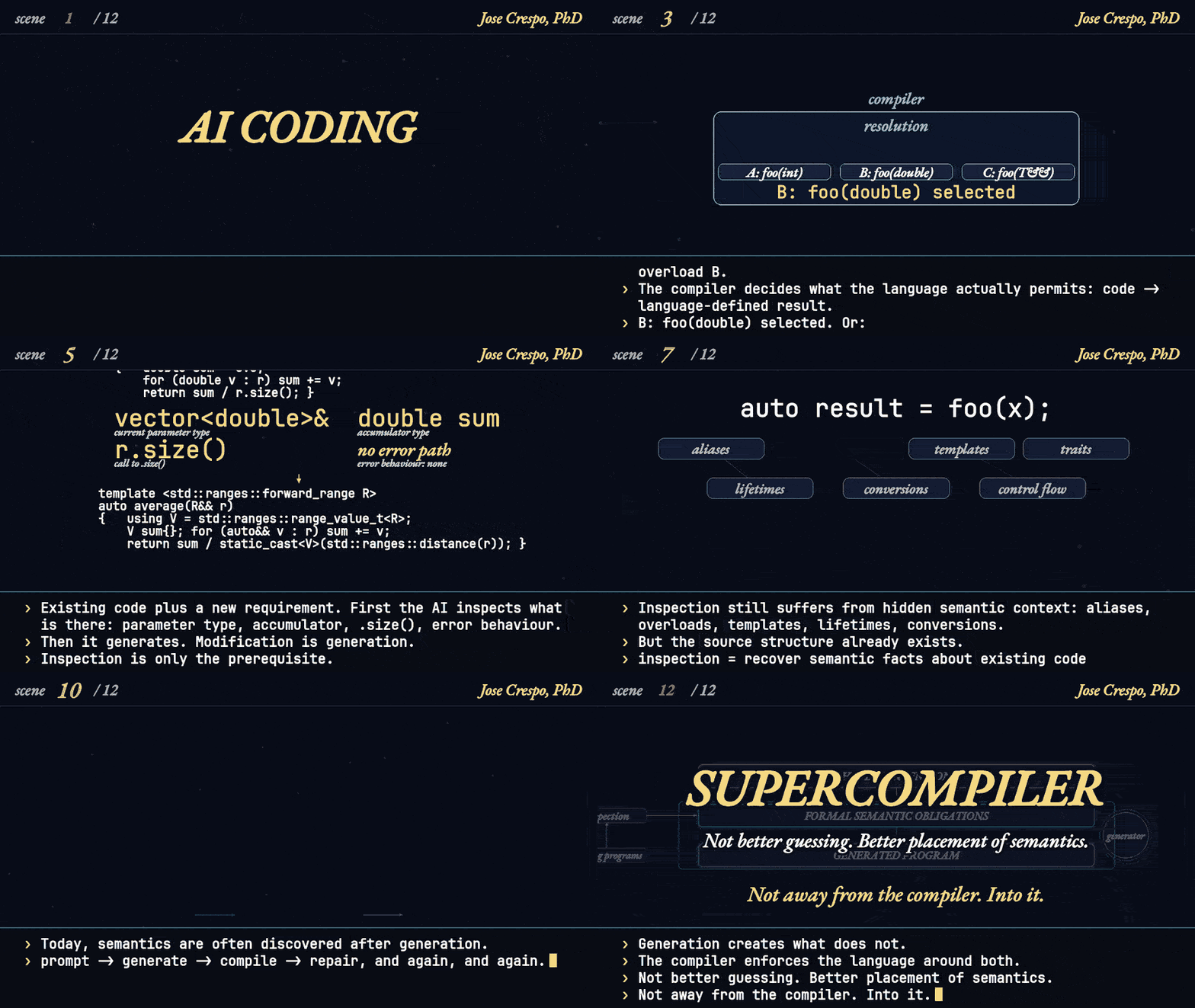
Now you have seen it clearly in the animation: when AI inspects code, there is already a concrete piece of code to analyze, even if it is incomplete, buggy, or does not compile. Its identifiers, expressions, APIs, types, control structure, and at least some ownership or lifetime choices are already present.
The AI can still get some of that structure wrong, but at least it has something concrete to work from. With code generation, much more still has to be figured out from scratch.
Inspection — existing code → recover semantic facts — is still difficult because languages like C++ and Rust hide a lot of meaning behind the visible text. The model can misread overloads, templates, traits, conversions, lifetimes, borrowing, or control flow, to name just some of the more obvious trouble spots. But it is still working from a structure that already exists.
With code generation, however, we enter a different world. Consider: