Anthropic's Fable and the Mortal Knockout Blow to AI
Anthropic's latest beast marks a point of no return for the future of AI.


We are living through a brutal artificial-cognitive age.
At first glance, the latest US government move against Anthropic’s Fable 5 looks like paranoid overreaction: Washington treating a frontier model as if it were the first child of Skynet, and the jokes write themselves. You know the continuation of the story: a coding assistant was suddenly handled like fissile material, and consequently access vanished worldwide.
Before we join the mockery, we had better look closer at the case.
Fable 5’s main hallmark, where it has beaten every competitor outright, is that it is the most capable AI software engineer to date. It can tackle and solve real-world problems, both at the surface level and deep within software systems. This alone puts Fable 5 at the limit of what LLMs have been able to achieve so far
You want examples?
Stripe, the payments company, pointed Fable 5 at Stripe’s own fifty-million-line Ruby codebase and asked it to perform a single migration across the entire system in a day — work the company estimated would have taken a team of engineers more than two months. Stripe described the result as compressing months of engineering into days.
Read that slowly.
Because the impressive part is not the line count. It is the deep semantic coherence.
That is not autocomplete at scale. It is engineering.
It kept coherence across Stripe’s own giant Ruby codebase and turned what used to be months of coordinated engineering pain into one migration task.
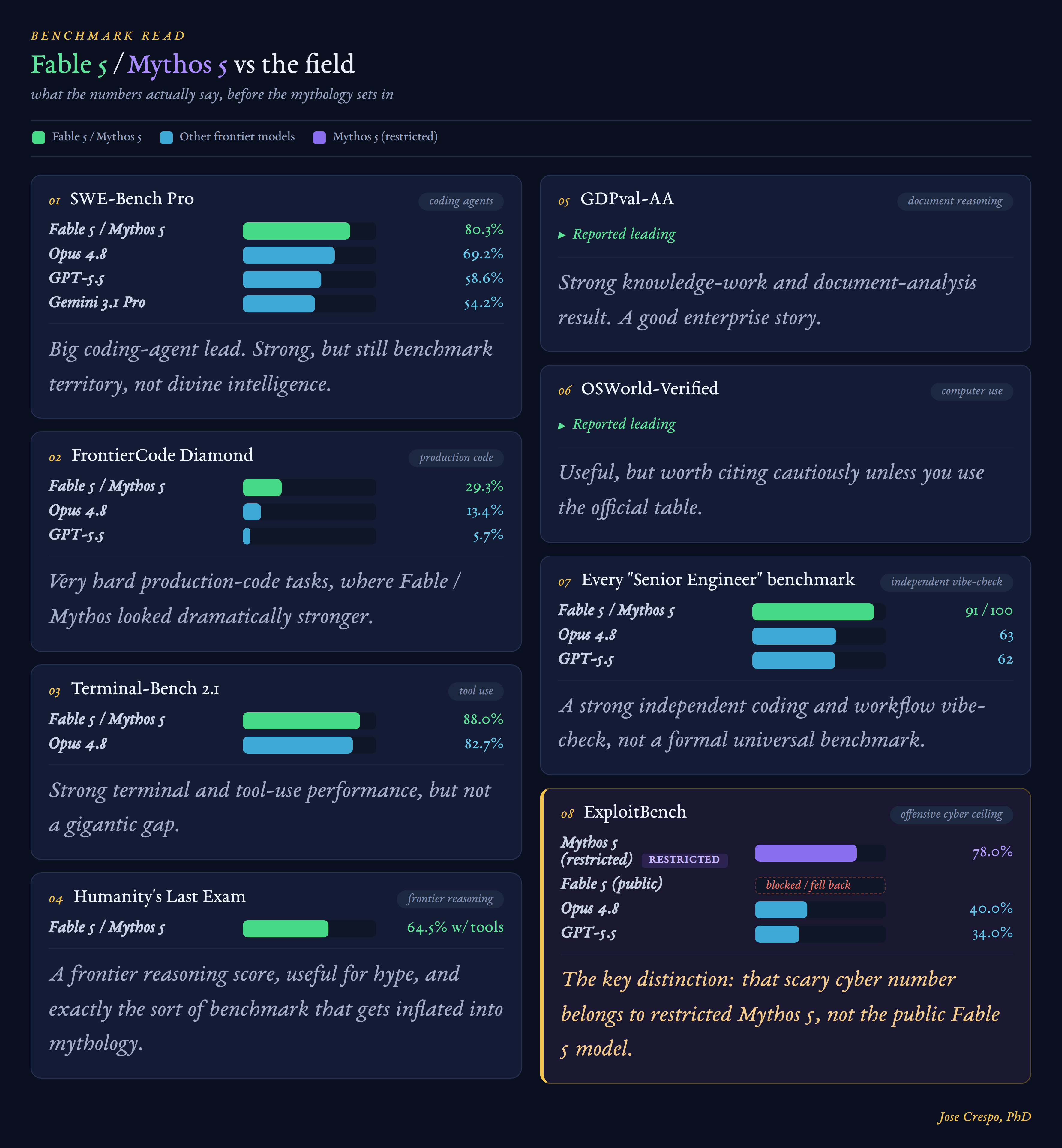
The benchmarks in the table above only confirm the example and show us how brutal the emerging pattern is.
Fable 5 dominates the coding stack, where that dominance makes the human software engineer without AI a real piece of archaeology: real software tasks, hard agentic execution, code quality, long-horizon work, and tool-driven autonomy.
And now I can already hear some critics — critics I can even agree with: benchmarks are not always a reliable way to prove the effectiveness of a modern AI, because those separate traits should be tested together in realistic scenarios.
Fine.
Fable 5 seems to have taken the challenge personally: it completed Pokémon FireRed from start to finish using only raw screen screenshots, with no maps, no navigation aids, and no hidden game-state information. Earlier Claude models needed a complex helper harness just to play Pokémon at all.
In plain English: it played the old Pokémon game like a human staring at the screen, not like a bot reading the game from the inside.
Why does that matter?
Because Pokémon sounds like a joke only until you remember what the game actually demands.
The model has to see through pixels, remember where it has been, navigate towns, caves, battles, menus, dead ends, you name it… recover when it gets lost, and keep going after thousands of small decisions.
That is not a toy skill. That is what we can call continuity.
And continuity is exactly what separates answering a question from actually getting something done.
Is Fable 5 Really That Good — And That Dangerous?
Now comes the surprise: how can a technology this excellent be treated, at the same time, as dangerous?
Paradoxical? Not after you have read this section.
Washington may have misread the mechanism, but it did not hallucinate the danger. The danger is real, though we can agree it is not where they think it is.
That contrasts brutally with Anthropic’s public position, which is straightforward: Fable 5 was built with heavy safeguards to prevent misuse in malware development, cyber abuse, and other high-risk domains.
But reality has derailed Fable 5 from that ideal safety track: it may be the best AI software engineer we have ever seen, yet it still struggles at the exact border where the same repair operation can mean fixing legitimate code in one context and enabling malware by repairing the wrong code in another.
So, putting it more clearly: give it vulnerable code and ask it to fix the bugs, and the model does that as you have never seen before. It does not only repair what you throw at it; it improves it as an engineering task, knowing where it fits in your workflows.
What is the problem? As I said, give Fable 5 the wrong context, and repairing those bugs can transform broken hostile code into working malware.
That is the danger. Not that Fable 5 is evil, but that it cannot reliably know what the repair is for. As happens with the whole family of transformer LLMs, they do not cleanly separate context from concept, because context and concept are folded into the same token representation, not carried in two different lanes. Do you remember the distinction between functor and profunctor?
So why the heck does the blunder happen precisely in the feature Anthropic has been selling as Fable 5’s killer capability?
Pay attention to this, because here the paradox snaps into focus: the same thing that makes Fable 5 the best AI software developer is also what makes it dangerous.
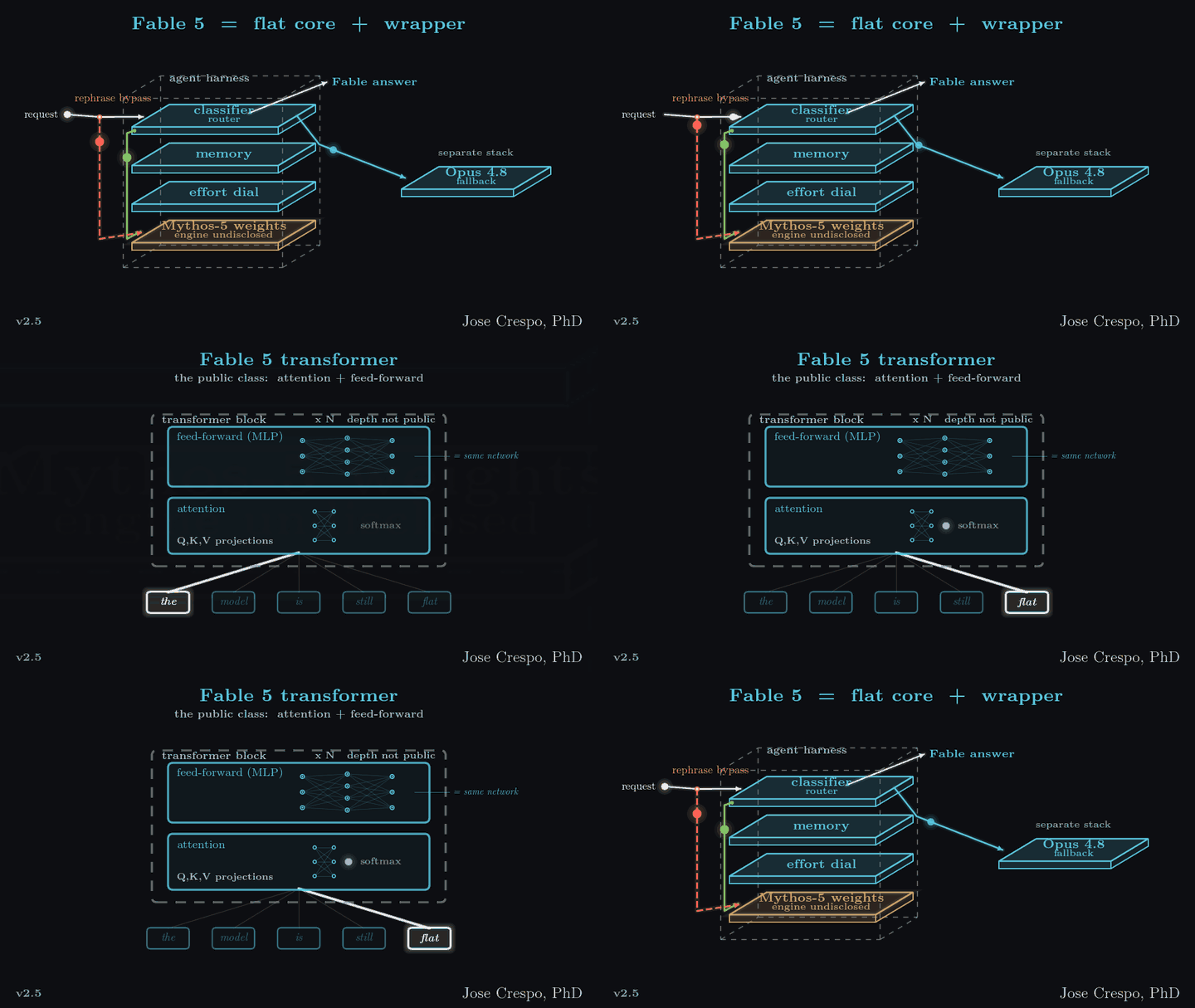
Fable 5 is still built on the same transformer family of technology behind every other LLM.
Look at the animation below and the trick becomes obvious