


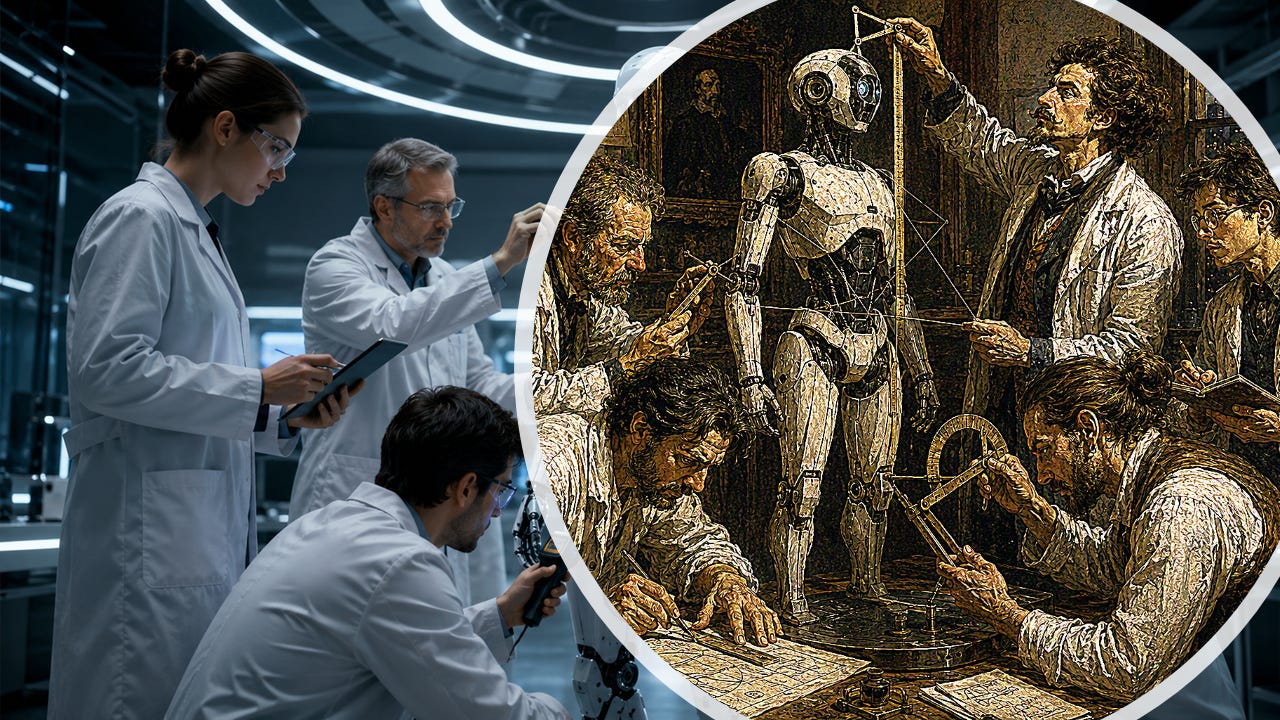
Welcome to the First TechUnderWorld Skool Crash Course
This is the first course in a series designed to prepare you for the next generation of AI—far beyond the usual tutorials, headlines, and recycled explanations.
We will not only examine what is broken in today’s AI.
We will explore the most serious mathematical and engineering ideas being developed to fix it: the same problems currently keeping the major AI labs busy.
But you do not have to wait for those labs to package the next generation into a product.
Here, you will learn how to recognize what is coming before it reaches the mainstream.
What is the trick?
The right mathematical and engineering mindset.
We will move through research papers, patents, emerging architectures, and recent mathematical developments to build a precise map of what is happening—both from above and deep inside the machinery.
You will learn which technologies could shape AI over the coming months and years, why they matter, and how to evaluate them for yourself.
That last part is the most important.
The goal is not merely to give you information.
It is to help you develop the skills and instincts to navigate the next AI wave independently.
TechUnderWorld Skool delivers hard facts, real mathematics, and serious engineering in simple language—told as an immersive, almost cinematic story.
Enjoy the course.
Prepare for a Semantic Machine, Not a Token Parrot
We talk to language models in messy human language: incomplete, ambiguous, and packed with assumptions we never bother to state.
And you already know the price. The same damn ritual: prompt. Correction. Clarification. Another correction. Five more messages…
Eventually, the machine produces something close to what we wanted in the first place… or not.
There are three reasons for this. And despite what the AI gurus keep telling us, only one of them is language itself.
Human language is much more than words. Most of the time, another person can understand what we mean from a few words, a gesture, or even a look.
Try that with a machine, and things can become complicated — or completely nonsensical — very quickly.
That brings us to the second reason: context.
Humans are remarkably good at separating the different, sometimes completely contradictory, meanings of the same word, gesture, or idea.
We do it almost effortlessly.
The same sentence can sound serious, sarcastic, affectionate, threatening, or absurd depending on who says it, when they say it, and what happened five minutes earlier.
Now imagine that same situation inside a transformer — the token-processing engine at the core of today’s LLM chatbots.
LLM Chatbots Are Sticky Tokenizers
Some of you may argue that self-attention does not keep every token locked inside its own little box.
And yep, you are right.
Each attention head updates a token by mixing information from the tokens around it, giving more weight to whatever the model considers most relevant. So there you have it: context is being handled. What is the problem?
The problem lies in what can happen when that mixing is repeated across layer after layer.
Think of making a salad. At the beginning, every ingredient is easy to distinguish. You can clearly see the tomato, the lettuce, the onion, and the cucumber. Then you add oil and vinegar and start tossing everything together. The ingredients are still there, but their flavours begin to mix, and the boundaries between them become less sharp.
Self-attention can do something similar with token representations.
It mixes and averages information again and again, so distinctions between words, meanings, and their roles in the surrounding context can gradually become blurred inside the model.
Residual connections and other mechanisms prevent everything from collapsing into one uniform soup, but the broader problem remains: concept and context are encoded together inside the same distributed cloud of numbers.
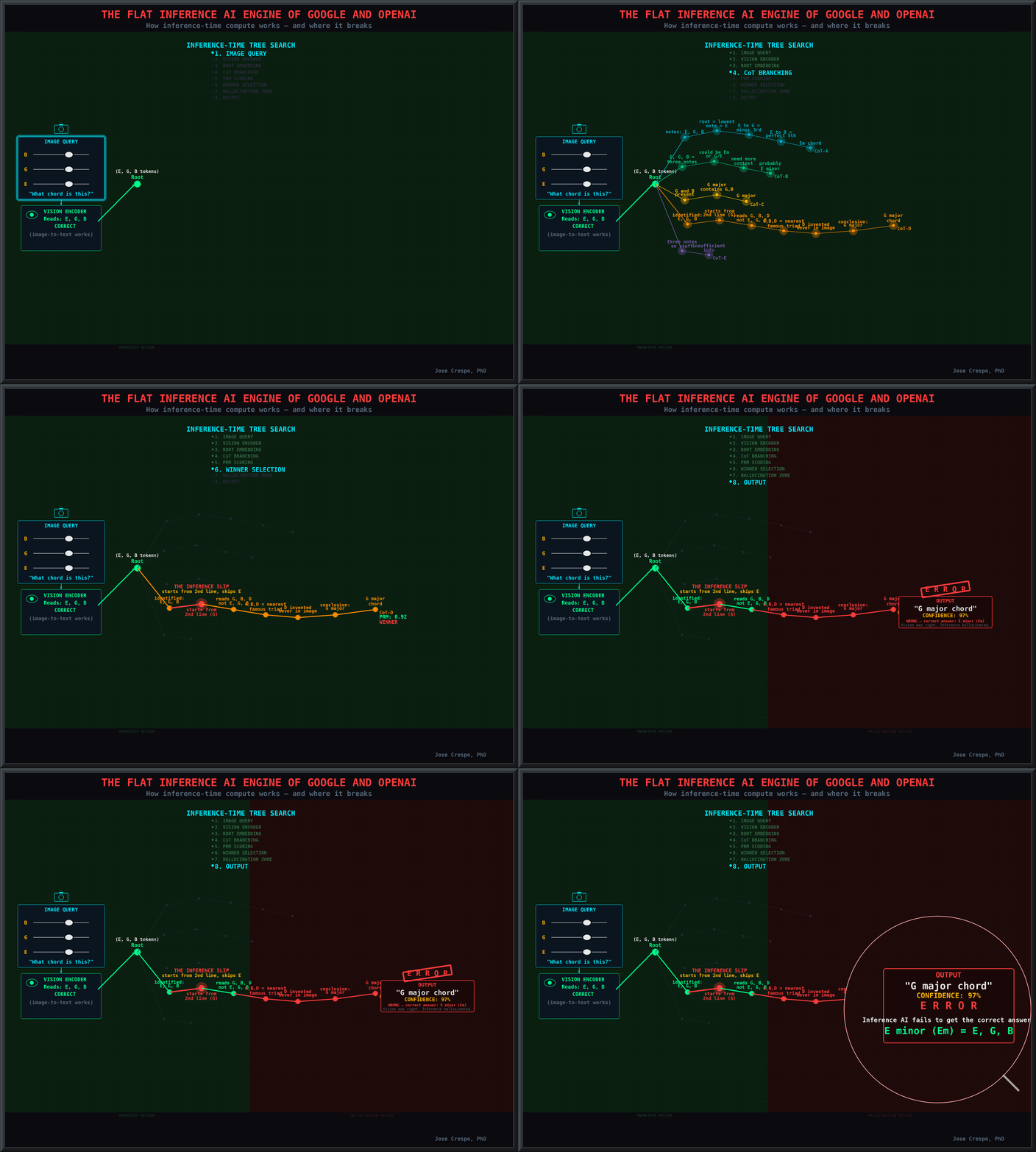
The information may already be there, but without a structure that connects it, organizes it, and shows how the pieces depend on one another, the machine still does not truly understand the problem.
LLMs learn contextual regularities from enormous collections of token sequences. They are extremely good when a new situation resembles combinations encountered during training.
But context is combinatorial.
Suppose meaning depends on ten contextual variables, each with ten possible states.
That already gives:
possible combinations.
No training set can explicitly cover them all.
Of course, the machine does not need to memorize every combination if it learns reusable concepts and rules for recombining them.
That is the whole trick.
Current LLMs do not always learn those clean factors. Sometimes they learn shortcuts, statistical habits, and correlations that work beautifully, until familiar pieces appear in an unfamiliar arrangement…
Take two apparently simple concepts:
justice and law.
Their relationship is not fixed.
It changes with the jurisdiction, the institution, the historical period, the type of offense, and the moral framework being applied.
We should really write:
In one context, legality and justice may largely coincide.
In another, something can be perfectly legal and still widely considered unjust.
Even within the same legal system, their relationship may change between contract law, criminal law, military law, or politically regulated conduct.
The words remain the same, but the relationship between them changes.
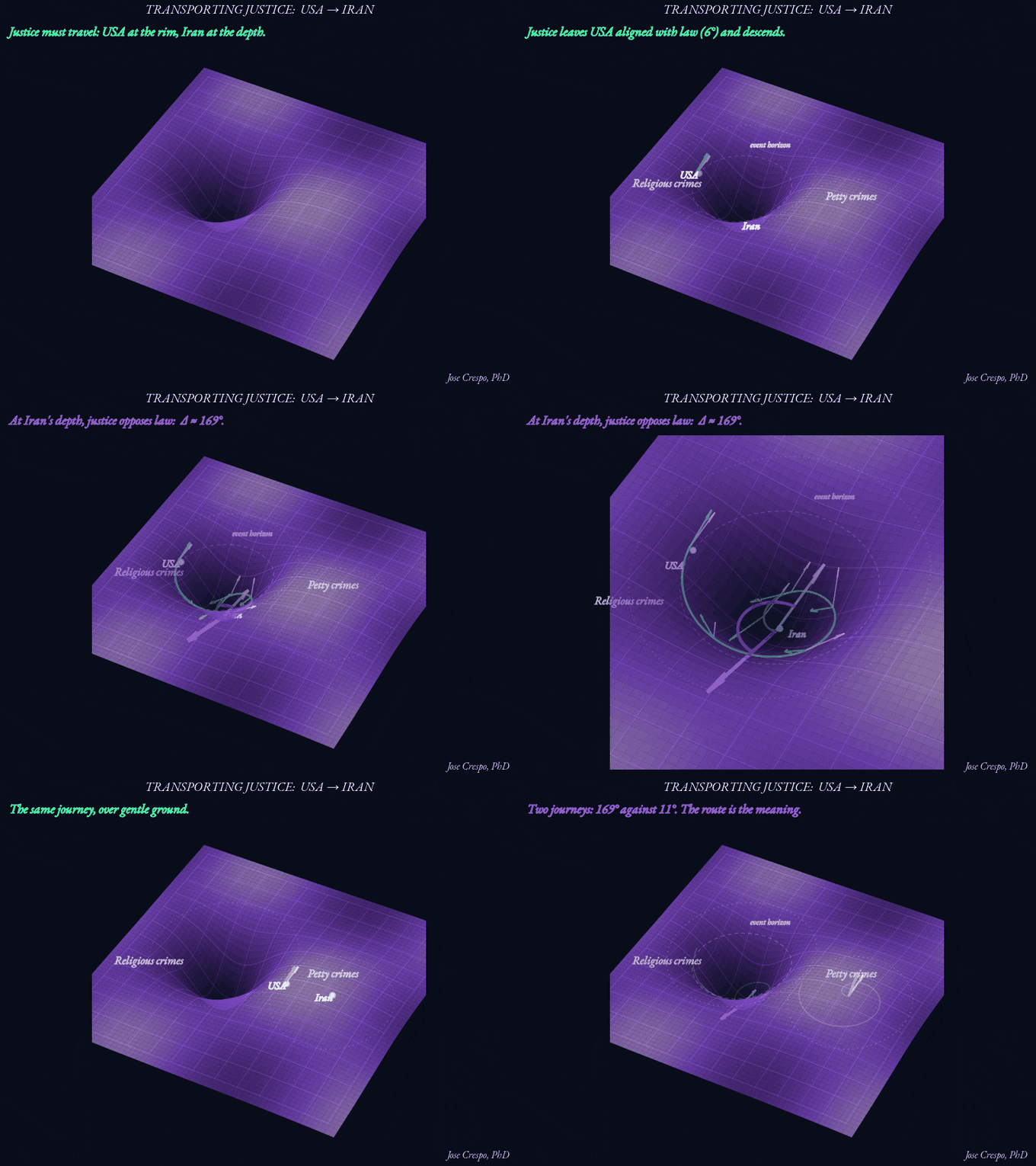
This remains difficult for current LLMs because, despite what many introductory AI explanations may suggest, processing context does not guarantee that a model will represent different contexts as clean, explicit, and separable structures.
In many real-world cases, legal, cultural, and religious assumptions remain implicit and entangled inside the model’s learned representations, as the animation above illustrates conceptually.
So how does the industry try to solve it?
By throwing more data, more parameters, longer context windows, and more corrective training at the problem.
And yes, the results improve, but only by throwing exponentially more compute at the problem, with energy consumption rising sharply alongside it.
Worse, getting more answers right does not mean the machine has understood why they are right. It may simply have learned better shortcuts through familiar patterns.
The next machine will need something more explicit.
Not merely tokens mixed with context.
A representation in which concepts, relationships, assumptions, and constraints can be inspected, recombined, challenged, and changed independently: a truly semantic machine.