


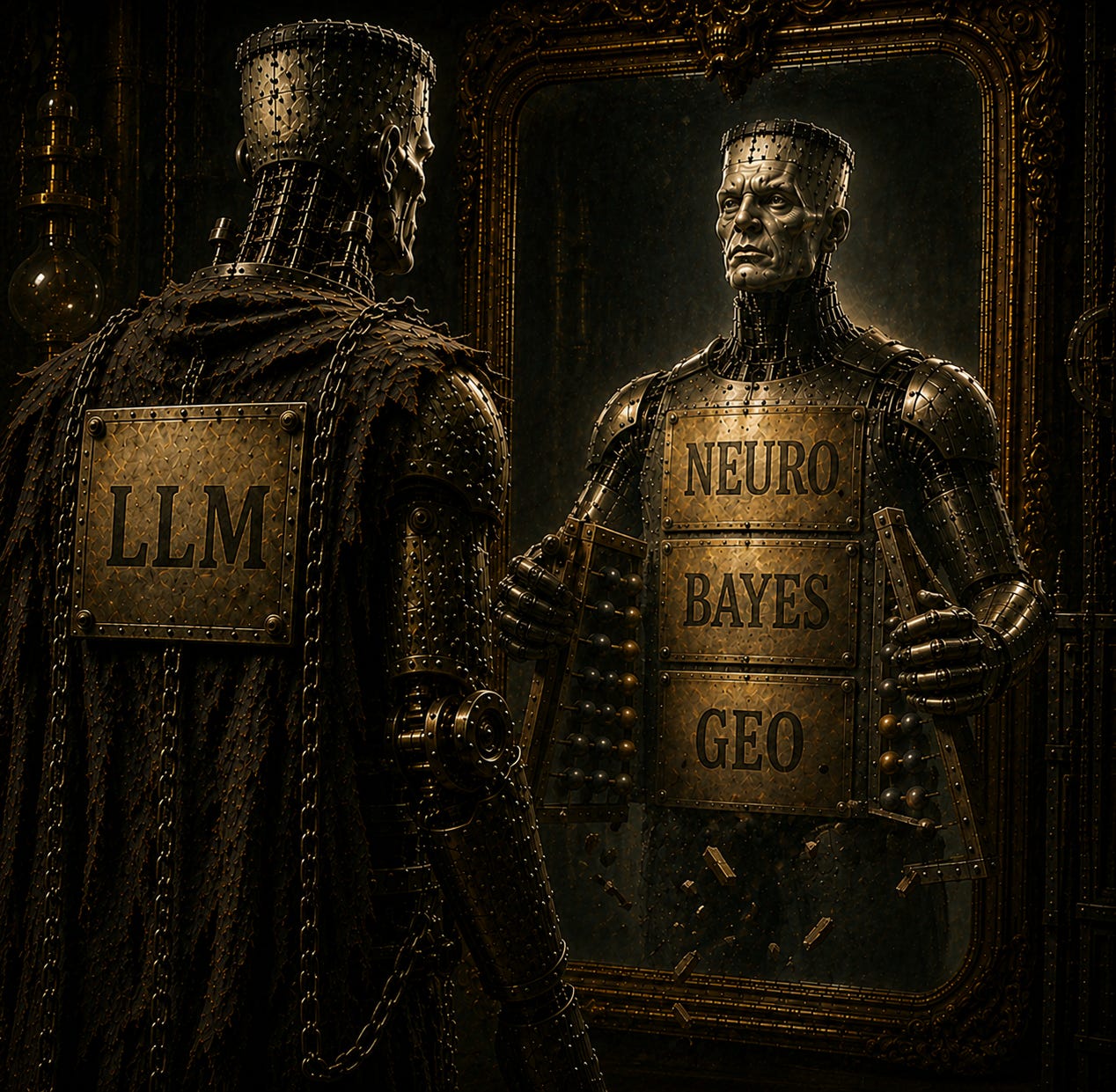
Whether you are an AI newbie or a senior AI engineer, you may be risking your future by using the wrong AI mindset.
Let me explain.
Most of us have been taught two fatal fallacies about AI.
The first is that today’s transformative generative AI is somehow the only possible form of machine intelligence — and that the road to AGI is simply to give it more speed, more memory, more data, and more compute.
The second follows directly from the first: that the mathematics and programming you need to learn are basically linear algebra and GPU programming. Forget geometry, topology and category theory. Forget Bayesian reasoning and probability distributions. Just multiply bigger matrices on bigger clusters and wait for intelligence to emerge.
But there is a problem, one the AI industry rarely puts center stage.
While the public is being sold an endlessly optimistic future of faster GPUs and ever-larger LLMs, the numbers are beginning to tell an uncomfortable story.
Today’s AI may already be approaching the end of its reign as the uncontested paradigm. You do not believe me?
Then look at the relationship between performance, computational cost, and marginal returns.
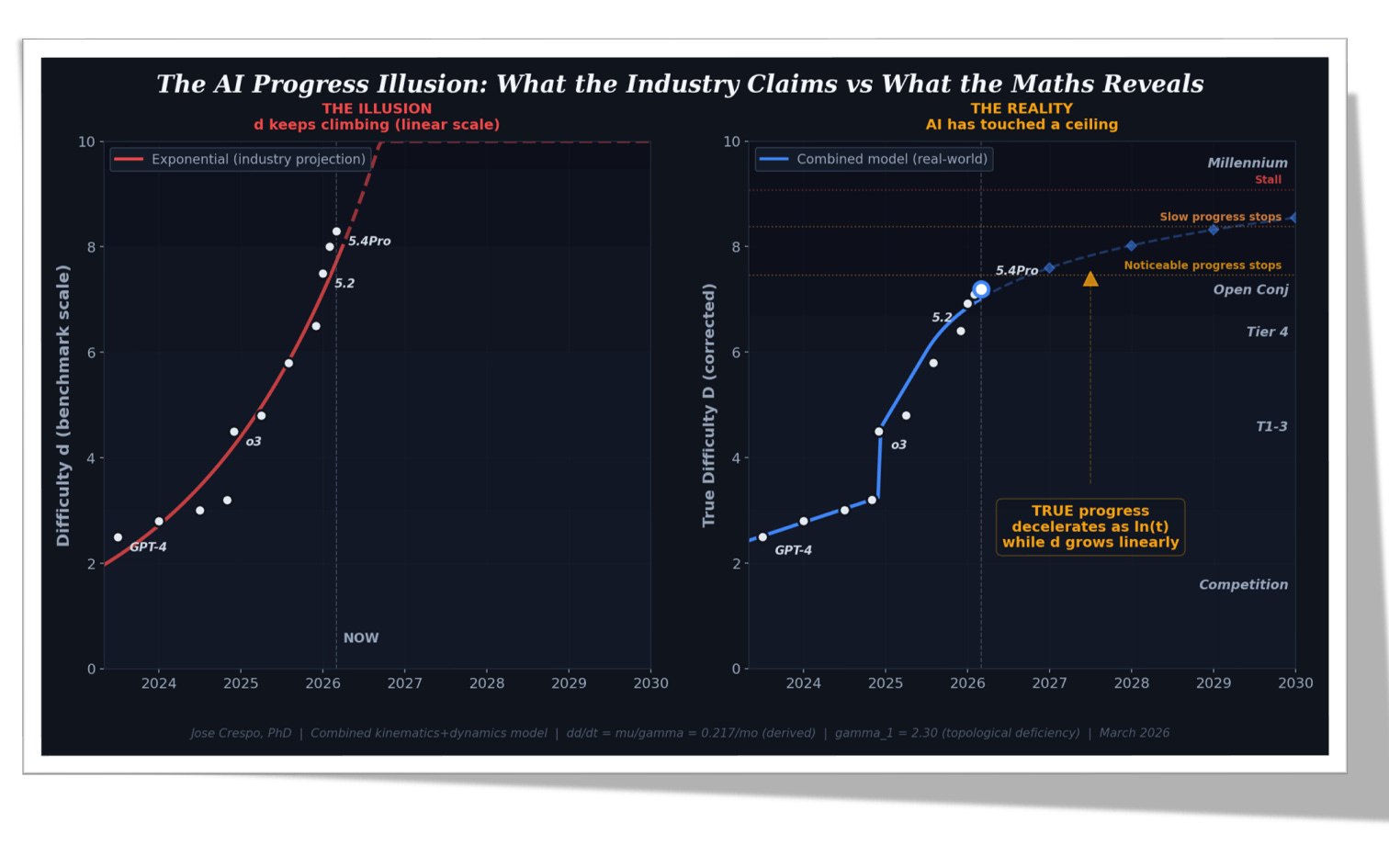
As computation, memory, parameter counts, and training resources increase, marginal returns do not rise proportionally. They begin to flatten. You spend vastly more to extract increasingly smaller improvements.
That means every new generation of frontier LLMs risks becoming dramatically more expensive — not merely in money, but in energy, chips, infrastructure, and computational complexity — while the gains become harder and harder to extract.
So the numbers leave us facing an inescapable conclusion.
Either a new breed of machine intelligence, built on new mathematics and new technology, takes over and resets this insane trajectory of escalating energy and computational cost…
or we may be heading toward a third AI winter.
And that new machine may look very little like the AI you know today.
Okay, I can already hear you saying: Sure, current AI has its flaws, but isn’t it still better to keep improving LLMs and building new frameworks around them than to bet on a completely different kind of AI that does not even exist yet and sounds like science fiction?
Not so fast, dear reader.
This new AI is not merely mathematics confined to books or technology still waiting for a blueprint. Startups and established companies are already building the technology, testing prototypes, and turning parts of it into real products.
Most of these systems are not mainstream yet. Some are still early. But the results suggest that they could move from the lab into wider use — and begin taking serious market share — over the next few years.
The New Frankenstein Factories Are Already Here
The next thinking machine is not emerging from a single laboratory.
It will emerge from an ecosystem.
And the right mindset now begins with understanding how that ecosystem actually works.
One company builds the nervous system.
Another develops the body.
Another specializes in memory.
Another teaches the machine to interact with the physical world.
Another models biology itself.
Even Google DeepMind, the company that currently comes closest to integrating many of these ideas under one roof, is better understood as the center of a much larger Alphabet ecosystem than as a completely self-contained AI factory.
Around it, Alphabet has built specialized organizations such as Isomorphic Labs, dedicated to AI-first biology and drug discovery, and Intrinsic, focused on intelligent robotics and physical AI. These companies operate independently, but collaborate with Google DeepMind wherever their technologies overlap.
That is the first sign that the future of AI is already changing before our eyes.
Until now, the standard model was simple: a startup grows around one star product — usually an LLM chatbot built on generative transformer AI.
Those days may be coming to an end.
Instead of one promising rookie startup, or one already consolidated giant laboratory trying to solve everything, we are beginning to see an AI industry organized around networks of specialized suppliers and cognitive supply chains.
And yes, Frankenstein is the perfect metaphor for what is happening.
Different companies are developing different parts of the same emerging system: better neurons, more capable bodies, richer world models, biological reasoning, and machines that improve through experience.
No single company has assembled the complete monster.
But the factory chain producing its organs is already running.
And here are the companies currently running the show — some old, some rookies, but all converging toward a new mode of AI production.
The consequence may be enormous: the LLM-based AI we have seen so far could end up looking like a mere cognitive toy beside what is coming over the next few years
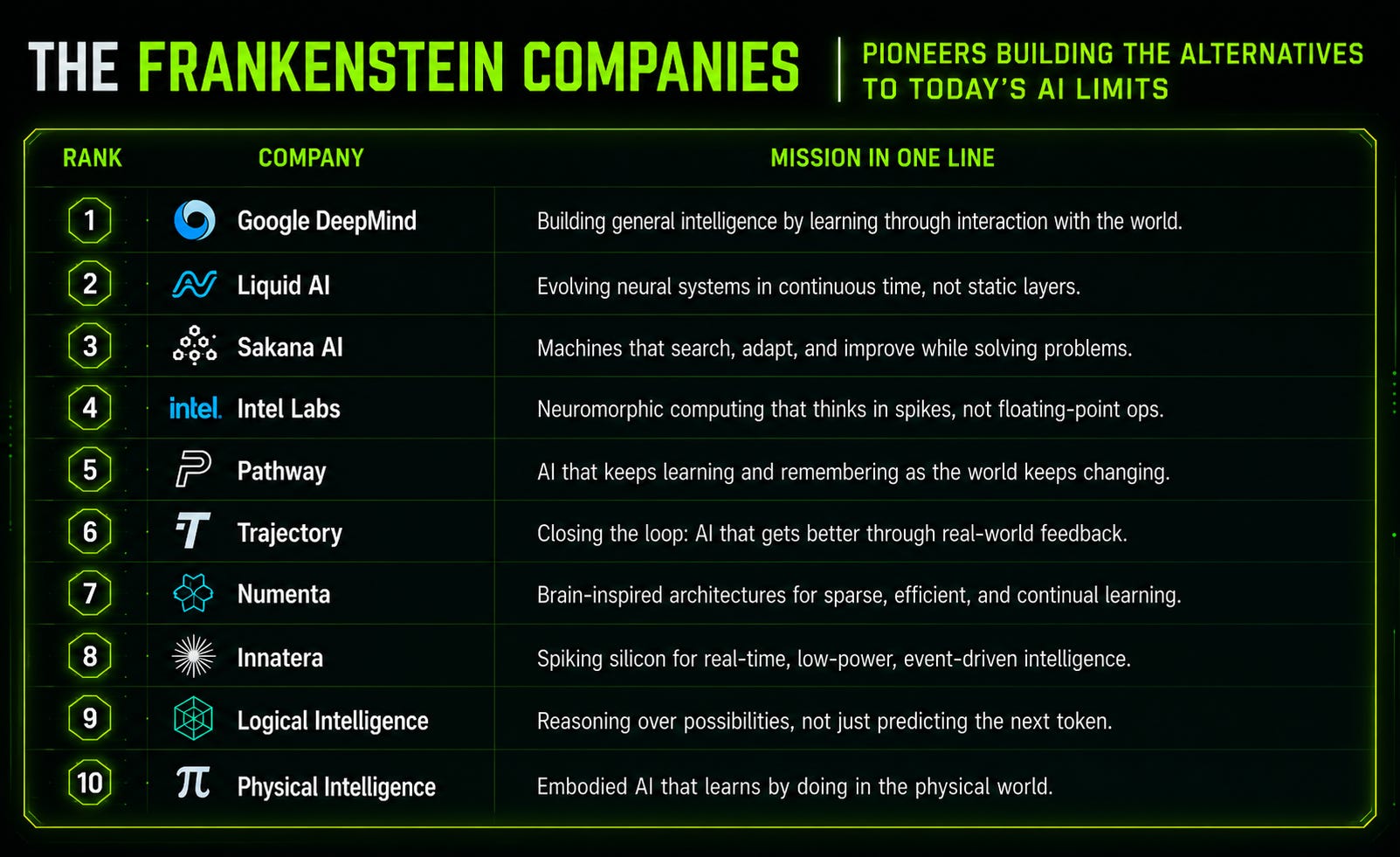
The Organs
Victor Frankenstein would feel strangely at home in the current evolution of AI.
The difference is that, instead of collecting a few dead organs, stitching them together, adding electricity and — well, you already know the rest — he would become an AI engineer and assemble something far more abstract.
Not biological organs. Mathematical organs disguised as technology.