



The Most Boring Tool on the Internet Will Decide the Future of AI
I hear you.
Adblockers? What the heck. Your story this time is about the most boring subject on the internet?
Exactly. It seems like that. And that is the trap.
Adblockers look like the most humble, almost miserable creatures in the entire internet ecosystem: tiny browser extensions working like little invisible shields, sitting there like silent stowaway icons near the address bar of your browser. Barely noticed by you. Credited by almost nobody, and nevertheless carrying the heaviest part of personal security on the whole damn internet
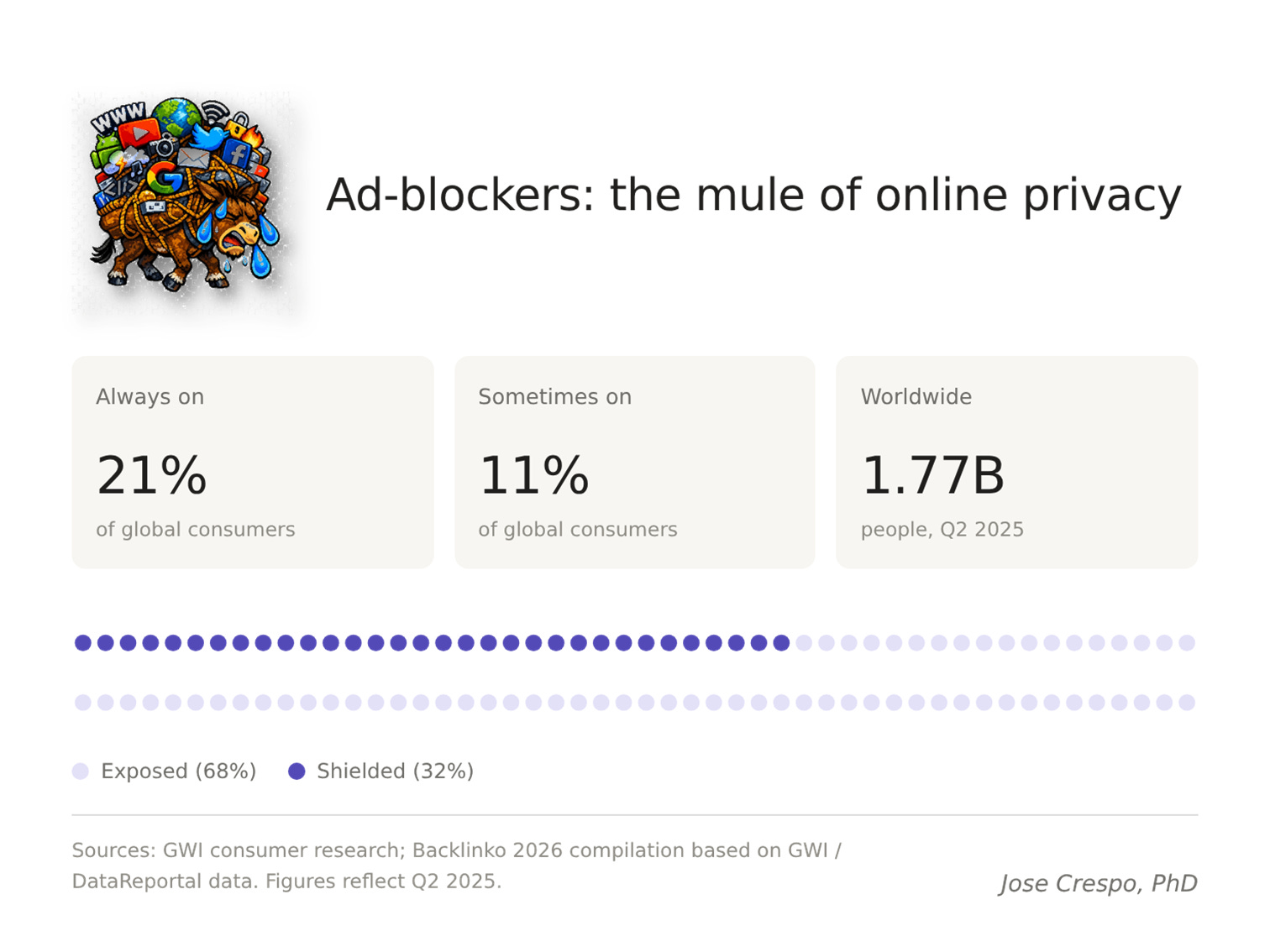
.But what if I told you that this ridiculous little shield is standing on the battlefield from which the next generation of AI may emerge?
You mean something different from my chatbot?
Yes. And much darker.
A new kind of AI built from the war over your personal data, coded and optimized inside one of the most profitable machines of our time: the surveillance economy.
We are talking here, dear reader, about an AI whose power does not come from having the biggest, baddest, smartest brain ever seen.
Its power comes from something more intimate, and far more dangerous: knowing you better than you know yourself.
The battle over your personal data in the wake of the Dark AI
Until now, the unglamorous adblockers have done their job better than most people realize. Good enough to frustrate the dream of total behavioral visibility.
In fact, they have spent years busting the chops of Big Tech’s biggest ambition: seeing enough of your online behavior to personalize, target, and monetize you. This is not paranoia. Alphabet itself warns investors that technologies which block ads or make personalized advertising harder could harm its business.
That is the smoking-gun proof.
Adblockers are not decorative toys. They are effective enough to bother one of the most powerful advertising machines ever built. And they do not only defend your privacy. They also keep the internet navigable: less spam, fewer popups, fewer aggressive ads, fewer paralyzing pages loaded with junk nobody asked for.
How?
By attacking the pipes.
They blocked the scripts, killed the trackers, weakened the fingerprinting, disrupted the cross-site linkage, slowed the whole extraction machine, and stood between ordinary users and a harvesting infrastructure built from ads, pixels, CNAME tricks, real-time bidding networks, and broker profiles.
Every one of them a little invisible hook designed to turn human behavior into money.
Not bad at all for a few miserable browser extensions with terrible marketing.
But they do not all fight the same fight.
Some are better at killing third-party trackers. Some work almost everywhere. Some go deeper into the browser. Some are just very good at blocking the pipes where your data leaks out.
So let’s look at them properly.
The table below is not a beauty contest. It is the old battlefield, layer by layer: who blocks what, who only slows it down, and who still keeps the surveillance machine sweating
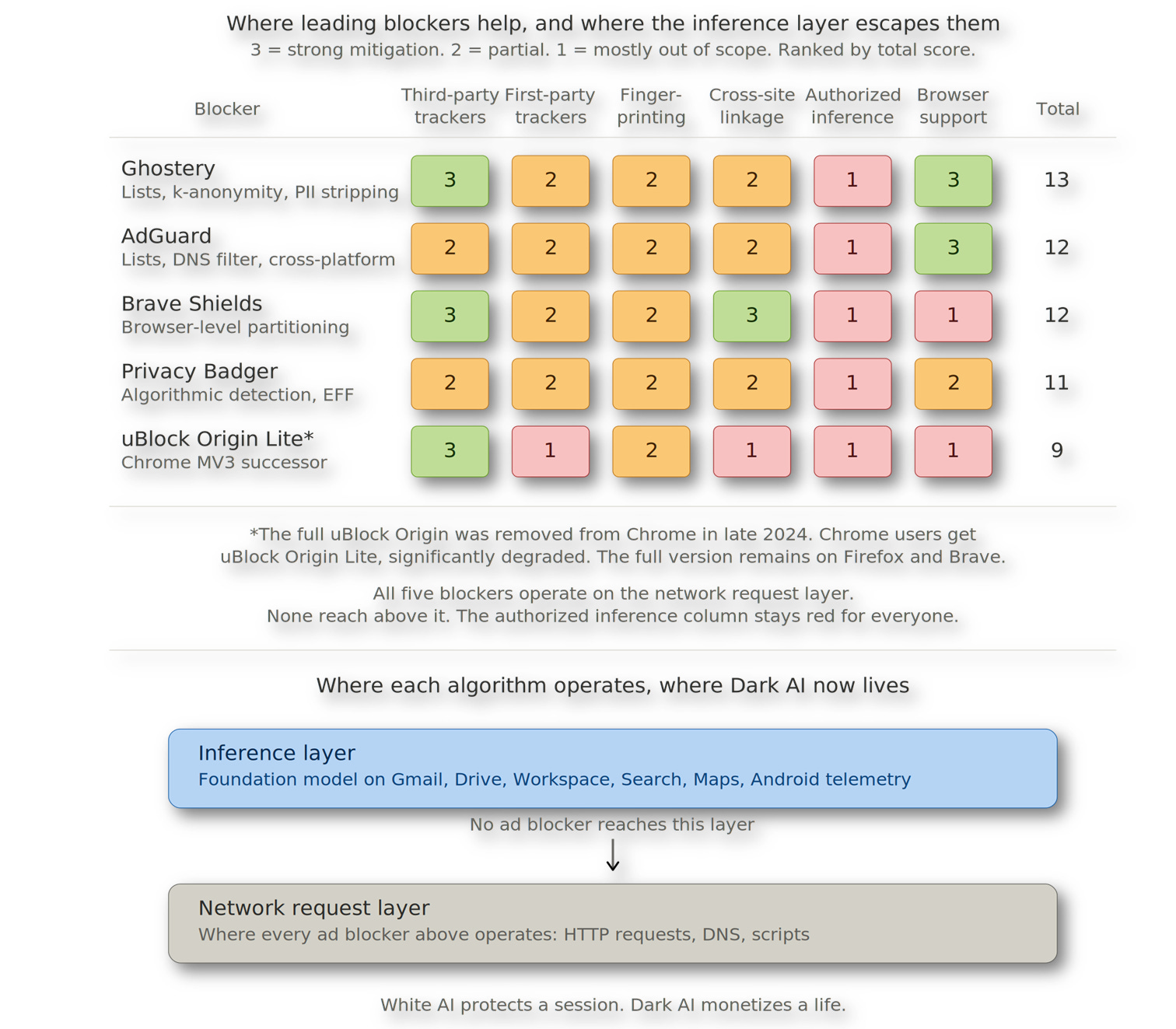
Among these quiet internet heroes, Ghostery stands out as the paradigmatic adblocker. Not because it does one magical thing, but because it does several practical things at once.
It does not win by being a silver bullet. It wins by being a stack: a layered shield, a small privacy machine built to fight the old surveillance web without making the normal web unusable. That is why Ghostery works so well as a canonical example.
You can see that logic in the animation below: how it works in full action while you navigate the dangerous wild web on your phone or laptop, keeping your session cleaner, faster, and harder to exploit.

So far, nothing looks broken.
Your Ghostery shield is awake. The little hamster is running in the wheel. The browser feels cleaner. The page loads faster. The obvious junk gets blocked before it can feast on the session: trackers, scripts, popups, fingerprinting attempts, cookie traps, and all the usual garbage trying to turn your browsing into someone else’s money.
Good. That is the old war.
But now look again at the table above. There is one column where everyone fails.
Authorized inference.
That low score is not a technical footnote. It is the crack in the castle: the Achilles’ heel of adblockers.
Adblockers are very good at guarding the browser door. But the inference layer does not need that door.
The inference layer works with data already authorized by you, already collected, already inside the app or cloud, waiting for a model to connect the fragments.
That is where the nightmare begins. But what the heck is the inference layer?
This is only the small introduction to a much bigger story.
What continues behind the paywall is an immersive experience that will change how you think about AI entirely.
Please subscribe and enjoy this article, along with many more top pieces like it.