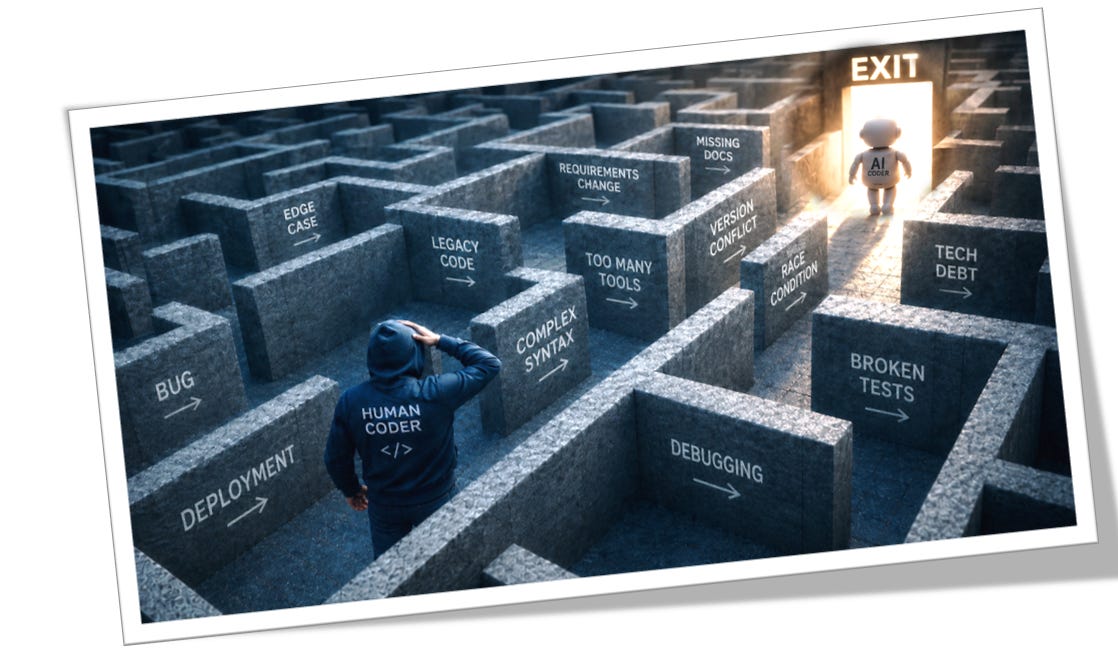
The AI industry will confidently promise to reinvent education, medicine, science, dating, warfare, and lately even your mortality.
But ask what its coding models can already do, and everyone suddenly turns into a nervous, defensive salesperson.
Well, it depends.
The model may produce incorrect results.
Human supervision is still recommended.
No kidding. Human supervision is also recommended when humans write software. That is why we have code reviews, tests, staging environments, debuggers, incident reports, and senior developers staring at broken deployments late into the night.
The strange thing is that AI coding is being judged by standards that human programmers have never met. One camp shows an agent building a tiny web app and announces that software engineers are finished. The other watches the same agent misspell a variable and announces that machines cannot reason.
Both conclusions are ridiculous, and both come from the same statistical mistake.
Everyone stares at the numerator: how many coding tasks did the AI solve?
Almost nobody checks the denominator: what kind of tasks were they?
And that denominator contains nearly the whole story:
Was the model asked to write a ten-line utility function or repair a payment system spread across forty services?
Did it receive the whole repository or three disconnected files?
Could it run the tests?
Were the tests any good?
Did the documentation match the code?
What kind of task was the model actually given?So here’s the first hint: whenever you analyse an AI coder, inspect its soft underbelly — the denominator: a ten-line function is not a forty-service payment system. A full repository is not three pasted files. A model with tests, logs, tools, and retries is not the same machine as a chatbot forced to guess from a vague prompt.
AI coding ability does not come from a clever little homunculus — a tiny programmer hiding inside the model and doing all the thinking.
It comes from the whole setup:
model + context + tools + feedback + human judgment
Change the setup, and the same AI can look brilliant, useless, or confidently break a system it never understood.
And this is where both camps rig the experiment.
The optimists show the cleanest run. The pessimists remove half the context, tie one hand behind the agent’s back, and present the crash as scientific proof.
Neither tells you when the machine is actually useful.
That is the skill worth learning: knowing whether the agent simply needs more context, has made a bad guess, has written code that only looks correct, or has wandered so far from the architecture that you need to drag it back by the collar.
Learn to spot the difference, and AI coding becomes less of a dark art — and more of a practical defensive skill.
SOFTWARE FOLKLORE IS LYING TO YOU
Let’s start with the myths that keep us from understanding AI coders — and from using them properly.
Look at the table below. These are the stories about AI that, if you’re a developer, you’re probably tired of hearing from other developers — even though, as you’ll see, the evidence points the other way.
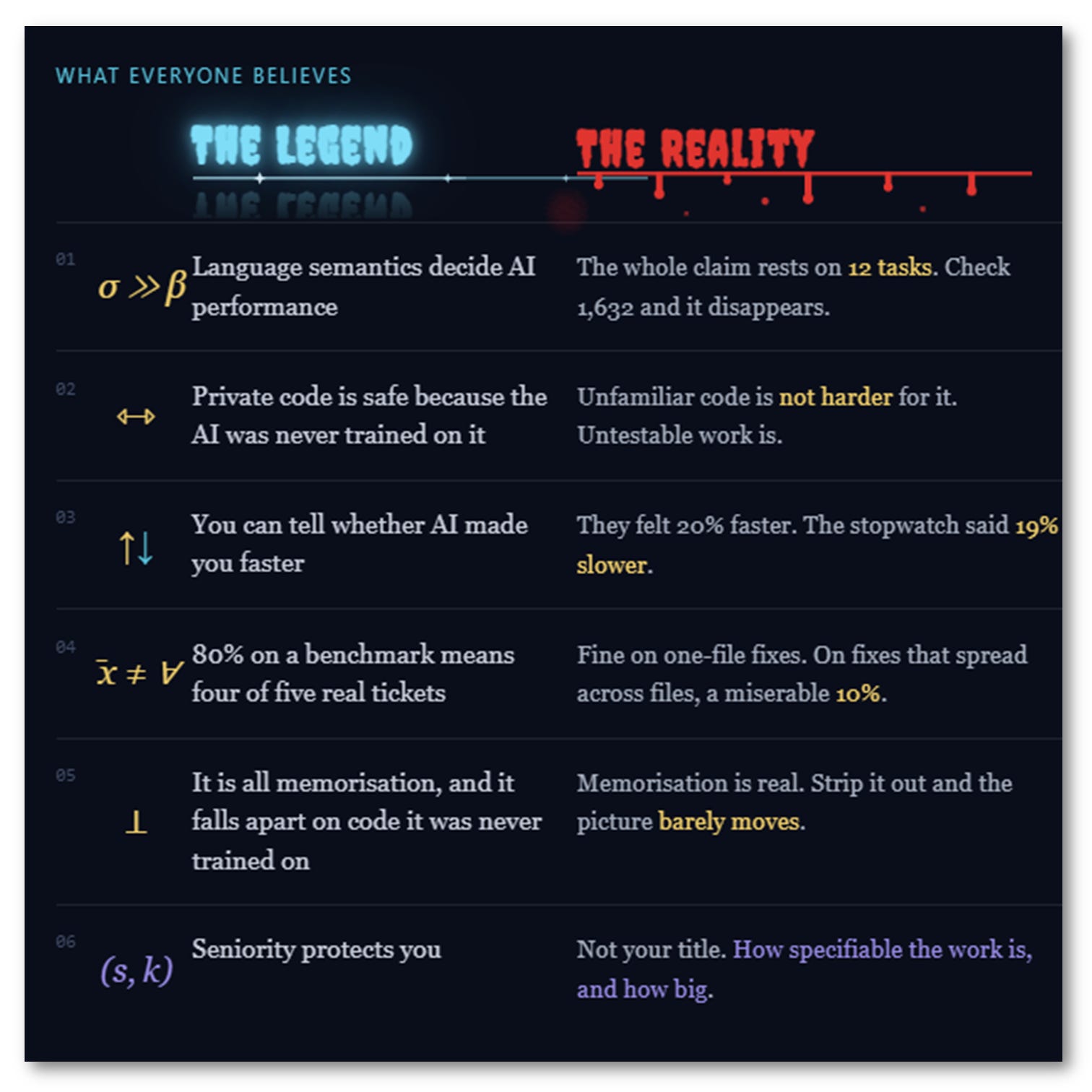
Software engineering is not uniquely irrational, of course. Every field has its favorite myths. But ours are especially bizarre because developers love talking about evidence … right up until AI coding comes up.
So let’s put those beliefs on trial and see which side the evidence actually favors: the techno-optimists or the techno-pessimists.
Spoiler: neither.
Myth One: The Parrot Alibi
AI coding only works because the model has already memorised the answer.