



Yes, you read that correctly… the title says lack of innovation.
Absurd, right?
NVIDIA is worth trillions. OpenAI owns the headlines. Jensen Huang is treated like a technological prophet, while Sam Altman is crowned someone like the Steve Jobs of intelligence. These are supposed to be the hottest, smartest, most innovative companies on Earth, the places everyone wants to work for and every investor wants to own.
Their genius appears beyond question.
But let’s step away from the marketing stage and go backstage, where the bolts, code, and machinery actually live.
There, a more dangerous question appears: What if the companies leading AI are not building the future, but blocking it?
Because the next breakthrough may not need a larger model, another generation of GPUs, or one more trillion parameters.
It may require abandoning the foundations NVIDIA and OpenAI have turned into dogma: flat statistics, fake neurons, and brute-force computation.
And that is where the masks come off — where we see the real face of these companies, and how the architecture that made them powerful may now be standing in the way of real AI.
A better path already exists. But AI must first escape the architecture that made today’s giants rich — and the technology dangerously fragile.
The current situation of NVIDIA and OpenAI
NVIDIA has two faces, like Janus.
The first is the face of marketing: the triumphant story Jensen Huang tells whenever he walks onto a stage carrying another GPU
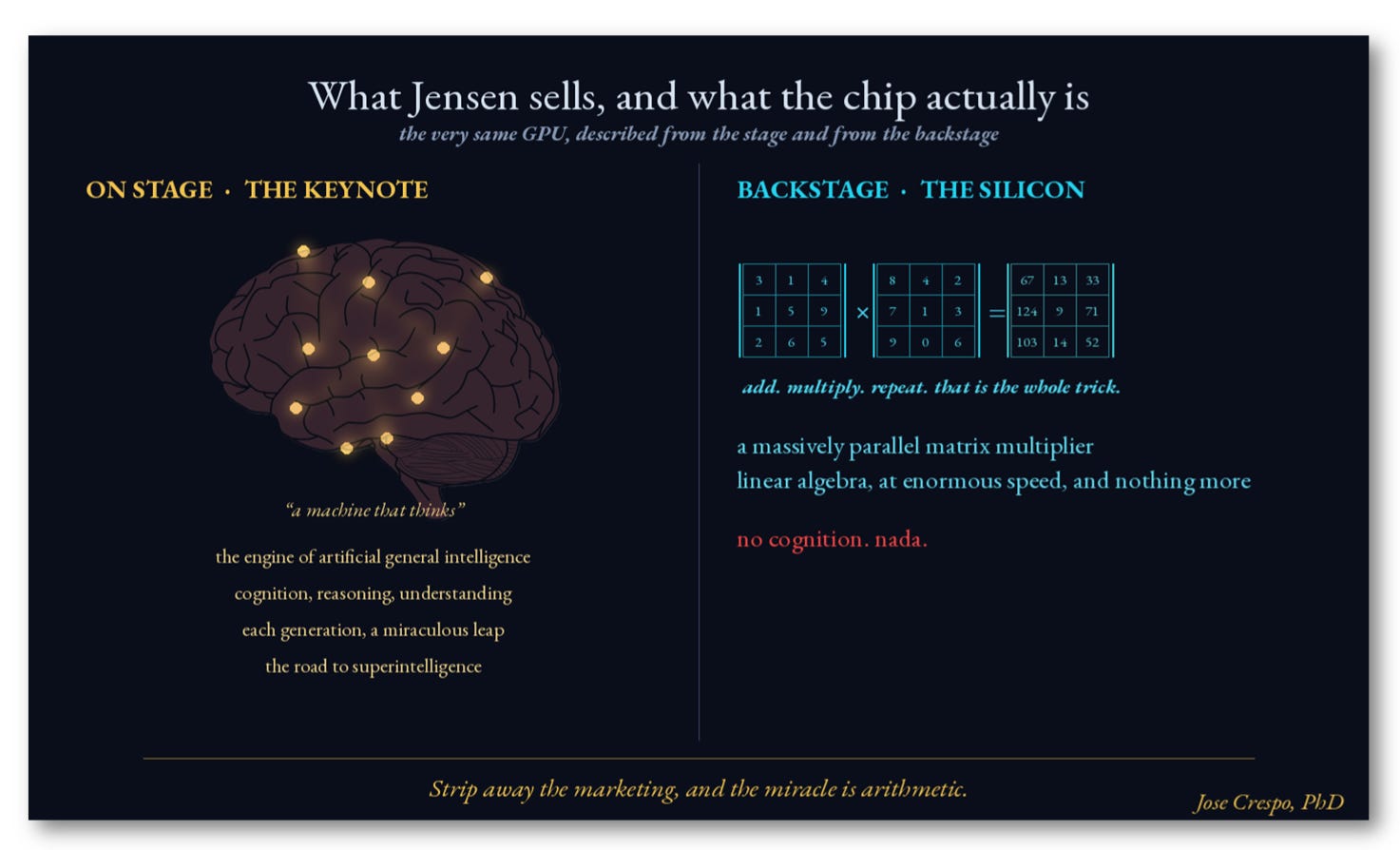
The second face is backstage, where the reality is far less glamorous.
Strip away the theater and one uncomfortable question remains: why are the descendants of hardware built to render graphics and animate video games now sitting at the center of the so-called AI revolution?
For most of NVIDIA’s history, gaming was not some side business. It was the business. Some veteran gamers will remember that, as late as 2014, demand for high-end GeForce cards still drove much of NVIDIA’s GPU revenue.
Of course, we have all heard the GPU evangelists preach the gospel: billions of operations, massive parallelism, oceans of computational power.
But once the spectacle is gone, the miracle looks much simpler.
A GPU is an extraordinarily fast machine for multiplying and adding numbers across enormous matrices. A glorified mathematical coprocessor: brutally efficient at arithmetic, yet showing no trace of the intelligence celebrated so triumphantly on NVIDIA’s stages.
Fine. Then perhaps the real secret is not the chip, but CUDA, NVIDIA’s distinctive software platform. Surely this is where raw hardware becomes programmable intelligence. Is CUDA the missing bridge between matrix computation and cognition?
Unfortunately, CUDA is a venerable platform introduced in 2006. Over the past two decades, it has accumulated new libraries, tools, memory systems, language features, and AI-specific optimizations. But beneath all those additions, its basic computational worldview has changed surprisingly little.
And CUDA deserves credit. It took the parallel power of graphics processors beyond graphics and opened it to general-purpose computing. At the time, the idea was revolutionary: launch thousands of threads, divide the work into blocks and grids, and make the GPU process enormous quantities of numbers at once.
But two decades later, a geological era in technology, CUDA still rests on essentially the same idea: break a numerical problem into even more parallel operations and run them even faster.
That is the whole trick.
A remarkable engine for accelerated computation. But still no bridge from arithmetic to cognition. Nope.