


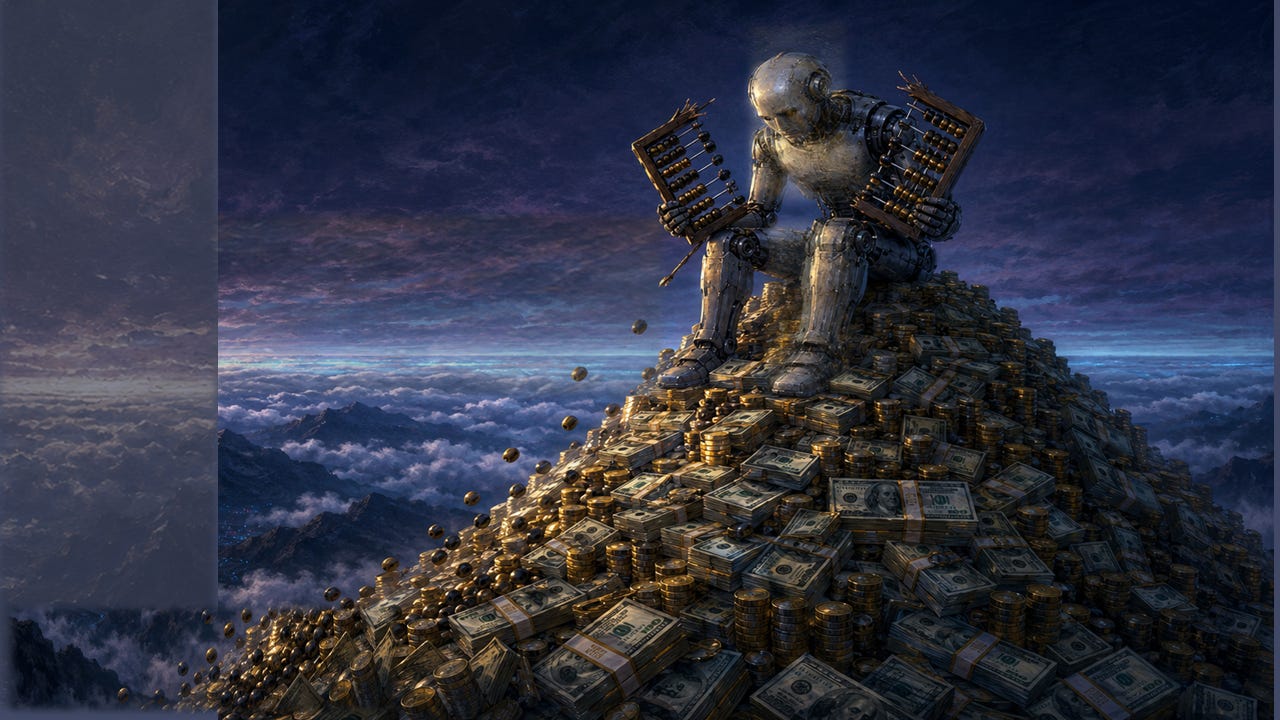
I Have Good News and Bad News for You
The bad news first, as tradition demands.
To everyone out there grinding through linear algebra, optimization, tensors, and the rest of the standard math that makes current AI what it is, hoping it buys you a privileged seat in the future: I am sorry, friends.
You may be headed back to square one.
Which is still better, anyway, than holding a ticket for the AI Titanic.
Because the math they promised would turn you into an AI engineer and programmer is, unfortunately, built on a broken arithmetic that somehow survived the greedy corporate filter. Yup … broken arithmetic.
I can already hear some of you.
“Oh no. Another bold article with a damn clickbait opening, chasing math dummies”
Fair.
But not this time.
And not in this series, if you have read me before. You know the rule here: the fireworks are allowed only because the foundations are real. Everything said in this story is rooted in pure mathematics, right down to the core of the argument.
Now the good news.
You will get that mathematics here without being buried alive under the old academic cement. Don’t worry. You will not have to suffer through the long ritual of incomprehensible formulae before you get the point.
You will have the core in the most pleasant way I can manage. Promise.
And if you are new to the field, or simply curious about AI, we will provide you with a vision and a perspective you cannot find anywhere else on the web, in books, or in whatever media is currently available.
To my knowledge, you are reading the first published debunking of one of the holiest dogmas of the current AI industry: that beneath the GPUs, the scaling laws, and the trillion-dollar sermons, there is a solid mathematical foundation.
There isn’t. Keep reading. You will see it break.
Surely You Are Joking, Mr. Mathematician
I know. It sounds insane.
It is hard to believe that current AI could be so mathematically limited after one trillion dollars and counting, with projections already pushing that figure several times higher before 2031.
Jensen Huang and the rest of the scaling priesthood have hammered the same creed into the industry’s skull: whatever is wrong with AI today will be fixed by throwing more computation at it.
You know the hammering tale. Every time one of those AI gurus is asked for their vision, the answer is always the same: more GPUs, more data, more parameters. More… you name it.
And to some degree, you can be forgiven for believing it. The surface is seductive. The chatbots get smoother. The agents get faster. The systems become more multimodal. Their memory grows heavier every quarter. The whole machine seems to be approaching something like superintelligence.
Until you scratch below the surface with a little mathematics … then the gold paint comes off.
Because the moment you stop watching the corporate spectacle from the outside and start asking what kind of algebra is actually organizing the machine’s internal decision structure, the problem no longer looks like a shortage of scale, memory, or GPU firepower.
It looks deeper. And far more embarrassing.
Current AI is running, at its structural core, on a kind of mathematics that cannot subtract.
Watch the first animation before you read another word, because once you see this visually, the whole argument stops being an abstraction.
It will become painfully obvious. Even to the least attentive reader.
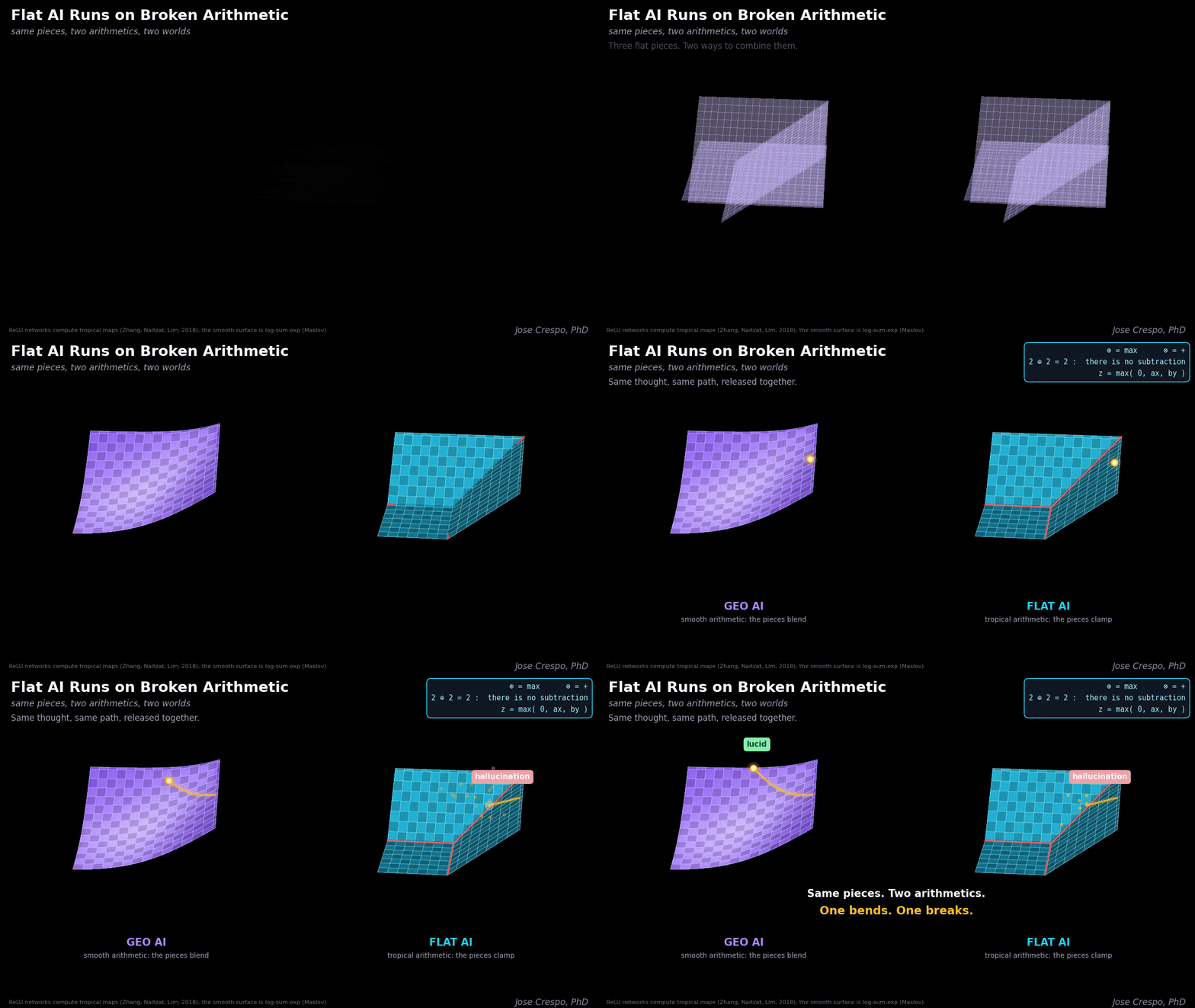
2 ⊕ 2 = 2: The Operation That Leaves AI Unable to Undo Its Mistakes
Time to run the math show promised at the opening of this story.