Our favourite LLMs have screwed us over more times than we care to admit. And the really frightening part is how much of their BS goes completely unnoticed.
Broken code that looked perfectly fine. Invented facts buried inside convincing explanations. Critical instructions quietly ignored. Hours of work built on assumptions the damn machine pulled out of thin air. I’m sure some of you still have the scars to prove it.
And every time you catch another screw-up, the same paranoid thought starts looping through your head: How many more are hiding in the stuff I’ve already trusted?
And there we are, trapped like an insect on a strip of flypaper. The more you struggle to get out, the deeper you sink into a sticky nightmare of corrections, rewritten prompts, and endless forensic investigations into everything your bloody AI has spat out.
The more serious your project, the less you dare trust the machine supposedly doing it for you.
And eventually comes the ultimate humiliation: you end up rebuilding the damn thing yourself.
Think about the absurdity of that.
We’ve built an AI industry capable of generating work faster than humans can inspect it, while making those same humans responsible for catching every mistake that matters.
And here comes the most Kafkaesque twist of all: the industry’s grand solution is to pour another trillion dollars into making the very same kind of AI even bigger.
What if the real problem isn’t that today’s AI needs to become bigger or smarter, but that we’ve built the wrong kind of AI in the first place?
Yes, I know. It sounds outrageous. Perhaps even ridiculous, considering the fortunes, reputations, and supposedly brilliant minds invested in the current AI paradigm.
But I’m not here to spend another article explaining why today’s AI keeps screwing up. As mentioned, you’ve probably accumulated enough painful evidence of that yourself.
So don’t worry. This story is about something far more adventurous: a new kind of AI that could make today’s LLMs look like primitive toys and finally put an end to the nightmare of checking every damn thing they spit out.
No, this isn’t some science-fiction fantasy. The building blocks of this radically different AI are already taking shape, grounded in new mathematics and backed by serious money.
And you’re about to see how it works, why it could overturn everything you thought you knew about AI, and just how close we may be to making it a reality.
WHY LLMs ARE THE WORST AI RIGHT NOW, IN A NUTSHELL
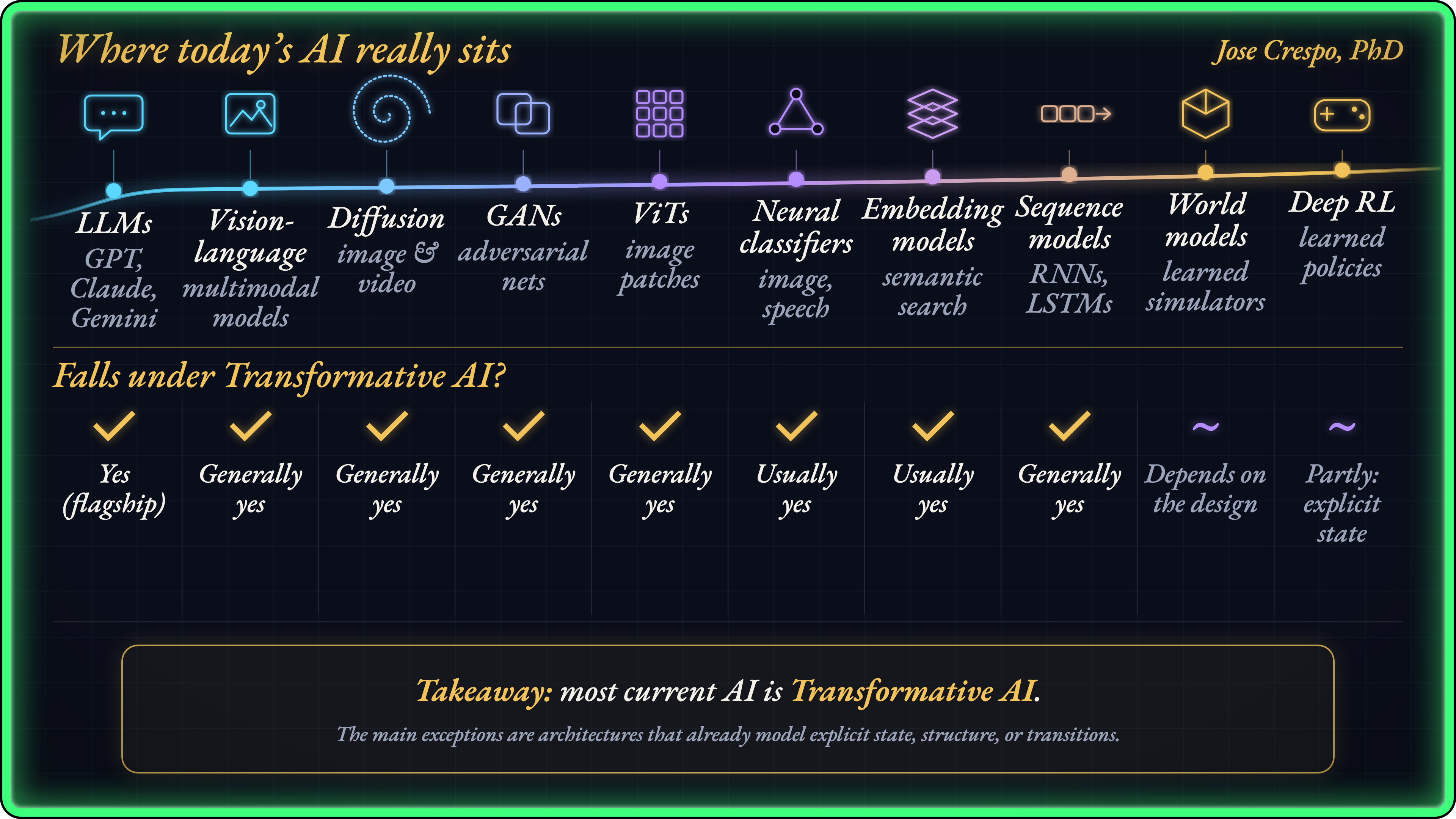
Transformative AI dominates today’s AI landscape, with LLMs as its most notorious offspring. Their hallucinations expose a deeper mathematical weakness: LLMs can learn complex contextual relationships, but nothing in their core architecture guarantees that meanings, assumptions, and permissions remain valid when contexts change.
Beneath all that apparent intelligence lies a rather crude mathematical imposibility: reconstructing an entire universe of meanings, objects, and relationships from statistical patterns learned through tokens.
The trouble starts with a distinction that sounds trivial but is anything but.
A word is not an object. A label is not a meaning. And a statistical relationship between two words is no guarantee of a valid relationship between the things they represent.
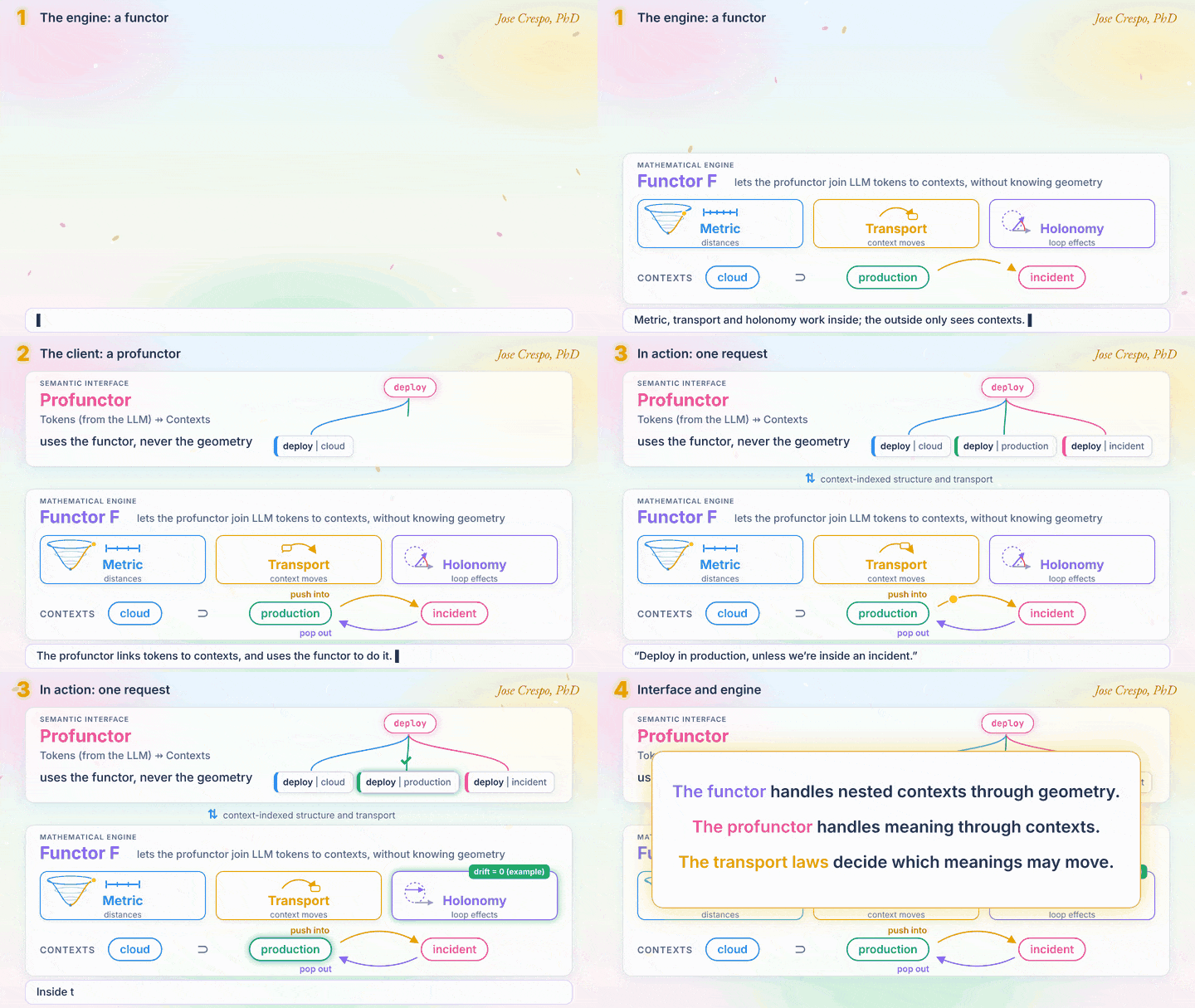
Take deploy.
Deploy what? Where? Under whose authority? In production, staging, or during a critical incident?
Same word. Different meanings, permissions, and consequences.
Now imagine those contexts nested inside one another:
Cloud infrastructure contains production
Production may contain an ongoing incident.
Each context inherits certain rules, restricts others, and can change what the very same instruction means.
An LLM can certainly learn these distinctions. But here’s the nightmare: the same tokens can mean different things across countless contexts, and those contexts can be nested differently, inherit different rules, or override one another depending on the situation.
Expecting a model to reliably handle every possible combination of meanings, assumptions, permissions, and nested contexts through training alone is a combinatorial nightmare.
Of course, LLMs can generalize beyond what they’ve seen. But generalization is not a guarantee of correctness, especially when unfamiliar contexts collide.
And if training alone had solved that problem, we wouldn’t still be dealing with so many hallucinations and costly mistakes in real-world AI projects.
And that’s the deeper architectural flaw: an LLM lacks an independently governed mathematical map specifying where each interpretation belongs, how contexts relate, and which rules must survive when moving between them.
CAN WE FIX THE LLM WITHOUT TOUCHING THE LLM ITSELF?
You bet! And we’re now in a better position than ever to fix some of the worst problems with today’s LLMs without touching the models themselves.
Instead of pouring billions into ever-larger models, hoping they’ll somehow learn to handle every possible combination of meanings and contexts, why not give them what their architecture lacks? A separate mathematical map of semantic contexts, with explicit rules for moving between them.
Sounds crazy? Not really.
The pieces are already taking shape. Symbolica, Topos Institute, Harmonic, and Britain’s ARIA Safeguarded AI programme are approaching the mathematics of more reliable AI from different angles, tackling some of the most stubborn failures plaguing today’s models: substantial performance degradation across multi-turn conversations and difficulties reliably reconciling instructions scattered across conversational turns.
So, from an architectural and mathematical standpoint, we can keep the LLMs, bring these mathematical structures together, and build an entirely new kind of AI around them.
More specifically, we can finally stop throwing words and guessed meanings into the same statistical soup.
Yes, we can now build an AI with a proper mathematical map of semantic contexts, one that distinguishes, for example, staging approval from production authorization, keeps assumptions tied to the contexts where they apply, and checks the rules governing movement between them. The details of how that new AI can work you have it in the animation below.
And if you’re wondering how the hell that would actually work, take a look at the animation below.