Bitcoin is sleeping. Not dead. Not finished. But the real story is happening somewhere else, and as I wrote here months ago, that story is AI.
AI infrastructure is quietly eating the rails Bitcoin was built on: the global transaction network, the plumbing of payments, settlement, credit, you name it. The new flavor of AI, with several agents working inside flexible workflows, is now challenging what once looked like Bitcoin’s indisputable future: not only as the enemy of traditional banks, but as the digital currency protocol of the internet itself.
But here comes the irony of destiny.
It has to be precisely Bitcoin that exposes one of AI’s biggest weaknesses.
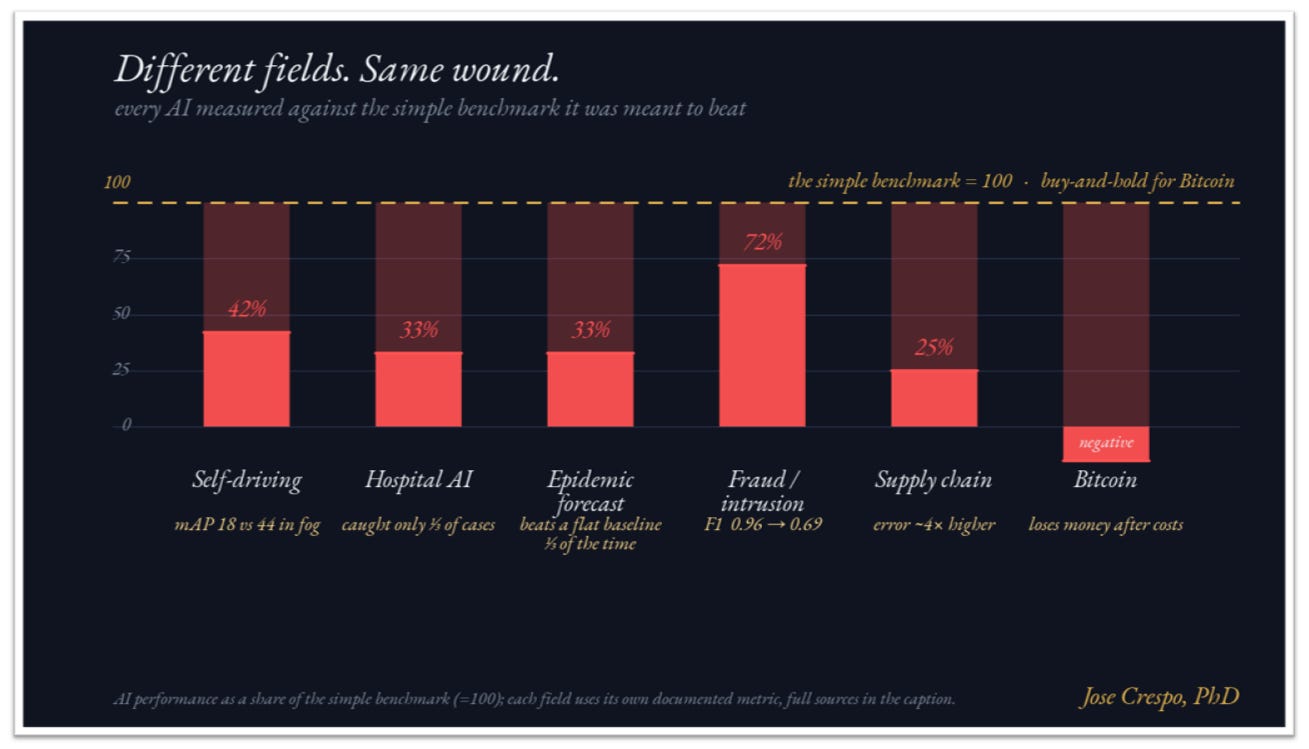
Because when you throw AI into hypervolatile markets like BTC, AI fails miserably.
And of course you can ask: so what? What is the problem if AI is not useful in hypervolatile markets?
The problem is simple. Hypervolatile markets are among the most profitable markets of all. More risk, more potential profit.
But there is a deeper point beyond the market itself: the inability of today’s monstrously expensive AI to cope with the kind of variable real-world problems it was sold as being able to solve.
So is there an alternative? Yes.
And it is cheaper, colder, and far more dangerous to the AI hype machine than many people would like.
And AI is not built for that. It is not built to cope with a world that changes under its feet while it is still calculating.
BTC Is Exposing One of AI’s Biggest Pending Blunders
The weakness, as you have probably already realized, does not stop at Bitcoin.
You can generalize it to most real-world problems, because this is exactly what reality does every day: it changes the conditions while we are still trying to react