


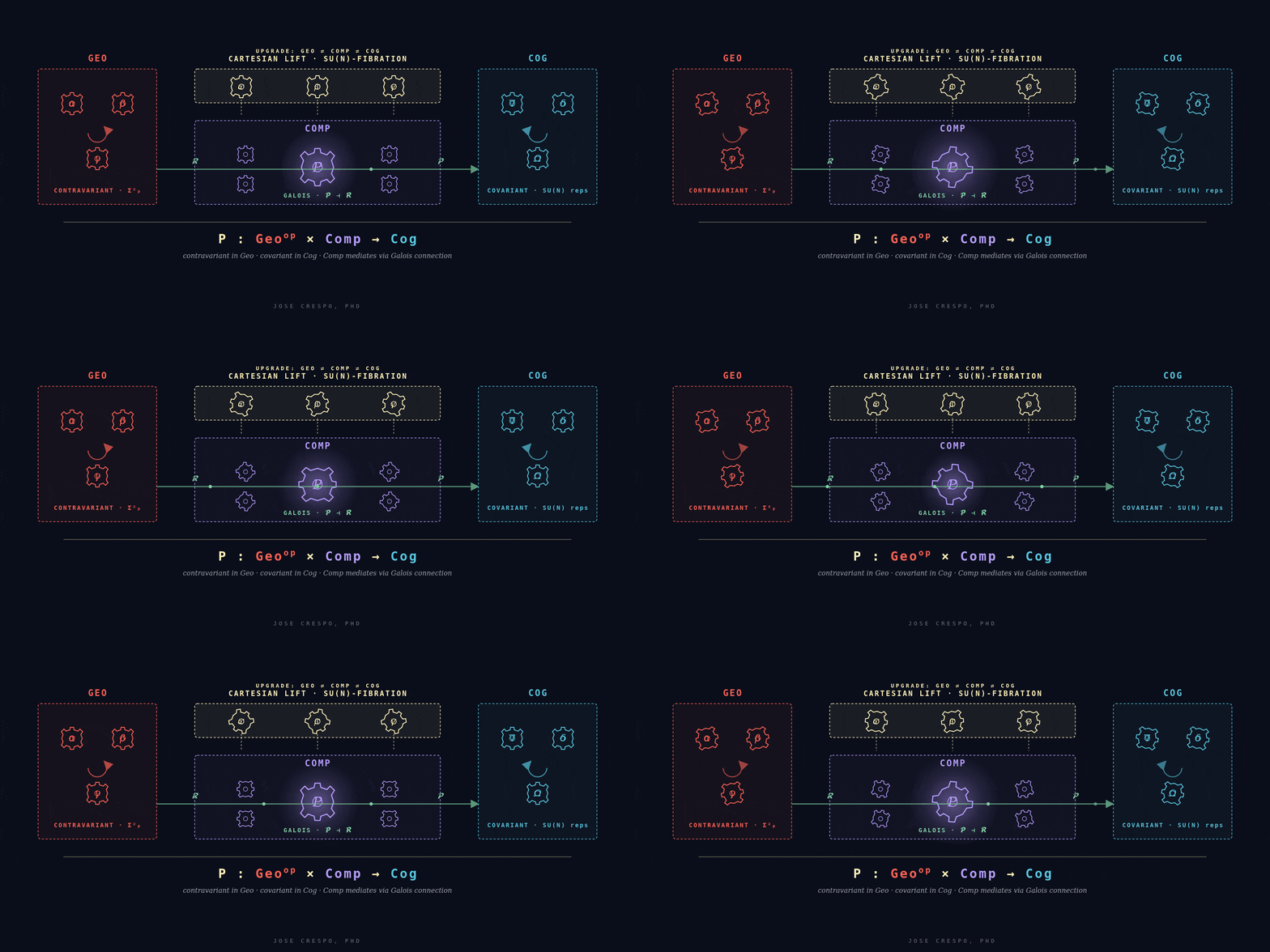
Nothing personal, just math
First of all, don’t be scared of the math here. You will get it, because I will use intuitive plots and animations to show you which math the big names are using to build the first true thinking machine. Yes, you read that right: thinking AI, not just another LLM parroting something that only looks similar on the surface.
How important is the new math the research labs at the big names are already working on? Important enough that if you read our previous article here, you already know the answer: where cognition and AI meet, mathematics is not a tool, it is the battlefield.
Until now, AI has behaved as if intelligence can be squeezed out of flat embeddings, bigger datasets, and enough GPU violence. That is the industry’s favorite superstition. But cognition is not a bag of vectors. It is a layered architecture of dependencies, transformations, transport, constraints, memory, inference, and self-correction.
Let’s start with the math ingredients in the recipe Anthropic and Google are using to build a genuine AI worthy of the name.
The labs are not inventing new mathematics. They are reaching back, all the way back, to the foundations the field abandoned when it decided that scale would be enough.
They are following, maybe without knowing it, the path Hilbert’s metamathematics opened a century ago when it taught us to step outside mathematics and study its machinery. For the first time, they are taking category theory seriously as architecture, not as a functional-programming side dish, to describe how structures compose. Put them together with serious differential geometry, Lie groups, topology, and information geometry, and they will get something far more serious than another transformer stack: they will get a blueprint for cognition built from the bottom up, with no arbitrary glue, no accidental layers, and no corporate fairy dust pretending to be architecture.
We can now say, for the first time, that we have a mathematical idea of how the increasingly fused Google-Anthropic partnership could build a new generation of machines that deserve to be called thinking.
Let’s build that machine the way they will.
The mathematics will become far less intimidating once the animations begin, I promise. This math is not decorative. It is the difference between a machine that merely predicts the next token and a machine that can begin to think in a way worthy of the name.
The reward?
A genuine AI architecture, unlike anything you have seen before